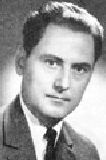
 "One professor I was very attached to at the Faculty of Mathematics was Martin Jurchescu. I studied his courses on analysis on manifolds and complex analysis in several variables. He had a special gift for presenting the hardest theorems of those courses in a way students could follow, so that, difficult as they were, they were a delight. He presented the harder parts of a proof with clarity and elegance and left the students to complete it with the accessible pieces. That is why his courses encouraged participation, creativity, and a passion for study and discovery. Over the years he founded a school, training many well-known professors and researchers in Romania and abroad. Besides the great pleasure of attending his lectures, for one semester I was his assistant for the course on Analysis on Manifolds, in the third-year research group. I had the chance to see how the exams in his subjects went. After the written exam came the oral. I was struck by the human warmth he gave off. One student had got muddled and received a low mark, a 5, but Prof. Jurchescu, sensing greater potential, gave him another question; the student really could not remember that part of the course. So the professor began to tell him a little of the proof at a time, to see whether he could carry it on, and he did. In the end he gave him an 8, telling him he could do even more and encouraging him to apply himself further. In other words, Martin Jurchescu cared less about the repetition of learned information than about the student thinking and being able to solve, with his own mind, small parts of a proof, even if helped with the rest. Developing creativity was a major aim for him. The exam thus became a joint effort: the student felt the professor's breath and his support along the way, and most often managed to show what he was worth.
He loved climbing and walking in the mountains. My wife Ioana and I went with him on a trip to the Bucegi. It was one of the most beautiful hikes: a silent harmony and contemplation of nature, broken by short stops and exchanges of words that breathed a philosophy of life. Although we hardly ever talked about faith, at one point he warmly confessed to us his unconditional admiration for Jesus Christ.
Later I heard that he had fallen ill with cancer. We visited him at home; he had grown very thin, but beside his visible suffering he kept a spirit full of devotion. His love for his wife, Anamaria, and his daughters, Martina and Ileana, breathed in his thoughts, his gestures and his sparing words. He thanked us for the visit, and we knew we might not see him again.
While he was still teaching at the University, in that last period, I had noticed that his handwriting was losing its neat, calligraphic character. Otherwise, his "aristocratic" nobility remained unchanged. May God forgive him and give him rest!"
Taken from:
http://florincaragiu.blogspot.com/2010/04/acad-prof-univ-dr-martin-jurchescu-1927.html