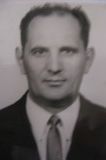
A grieving Christmas in 1973, after the death on 24 December 1973 of the man who had been head of the physics department of the University of Timișoara, Prof. Dr. Eng. IANCU HORESCU.
Who was IANCU HORESCU?
As Dr. Eng. Tiberiu Serafin (the first child from Domașnea who followed Iancu Horescu's advice and went on to complete his studies at the Faculty of Industrial Chemistry) said in his "FAREWELL" speech, from which I quote: "The story of the life of Professor Dr. Eng. IANCU HORESCU begins with 'once upon a time, in the ancient commune of Domașnea, there lived a husband and wife, hard-working, big-hearted peasants, who had three sons, proud and tall as fir trees.' One of them was IANCU."

Iancu Horescu speaking at the reunion of the village's sons and daughters on 5 July 1972
Let Iancu tell us himself (from his autobiography, which we have in the original): "I went to primary school in my native village, 5 grades, because my parents could not afford to send me to high school, even though after the fourth grade I sat the entrance exam for the Boys' High School in Caransebeș and passed. Only the next year, at the insistence of the village teachers, did my parents sell a quarter of a hectare of land and send me to high school, together with my brother Nicolae Horescu, who was in the fourth grade.
I attended all the grades at the 'Traian Doda' Boys' High School in Caransebeș as a regular pupil, except for the fifth, which I did without attending, for financial reasons. My father had been called up and sent to the front, although he was 45. All through primary school I was ranked first, and so it was in high school for 6 years of study. At the BACCALAUREATE exam in June 1948 I ranked first out of 106 candidates from the high schools of Caransebeș, Lugoj, Reșița and Oravița.
I wanted to study at the Faculty of Electrical Engineering, but not knowing drawing as a subject, I sat the entrance exam for the Faculty of Industrial Chemistry in Timișoara in 1948 and was admitted in first place."
From here on let his teachers speak, and his work, which we present below; let his colleagues in research and teaching speak, and his former pupils and students, who even after so many years have not forgotten him and have the highest praise for IANCU HORESCU the man. Iancu Horescu was great.
What fuller confirmation could there be than the work he left to the institutes where he worked, from his student days as a demonstrator, then as senior assistant, lecturer, head of the laboratories he himself created for research, Professor, Dean and Head of Department? I try to set down in writing, with the same emotion, now, 36 years after his death, what was said by those who spoke their final FAREWELL at his bier.
Let us begin with the most authoritative: his professors, collaborators, superiors and colleagues. Prof. Dr. Docent C. DRĂGULESCU: "IANCU HORESCU came first in the entrance exam in the faculty's first year of existence. He remained first throughout his studies, both in learning and in conduct, in every respect. A brilliant graduate of the faculty, he was kept on its teaching staff, as assistant and then as senior lecturer."
Sent for advanced study to Moscow State University, he worked under academician BALANDIN in the field of heterogeneous catalysis, earning the title of candidate of sciences, that is, doctor of chemical engineering. Back in Romania he became a lecturer in technological chemistry at the University of Timișoara, in the physical chemistry section of the Faculty of Physics. In the same post he soon became professor and at the same time the soul of the University's whole physical chemistry teaching. While teaching at the University, IANCU HORESCU founded at the chemistry centre of the Timișoara branch of the Academy the team that became a section, which began studies of CATALYSIS, with both practical and theoretical aspects. Some of these bore rich fruit, such as the destruction of nitrogen oxides, powerful pollutants, in industrial gases.
A member of the Scientific Council of the Chemistry Centre, Iancu Horescu constantly contributed his competence in research and his skill in bringing people together. In his soul there seethed a desire for achievement; he sensed its possibilities and saw the path to follow. He was imbued with the commanding vision of progress and was a restless slave to getting things done.
His perfect humanity served, with tact, more than once, to curb and settle the disagreements that always arise among people who work together. There were grumblers and detractors in his lifetime, and I found some in my research today among his successors and former colleagues.
Next, Prof. Dr. Eng. V. COCHECI, Dean of the Faculty of Industrial Chemistry in Timișoara, expressed his sorrow at the parting: "Iancu Horescu, counting his student years too, shared with us the hardships and joys of this faculty for almost 20 years of his short life. I knew him well, as a student and then as demonstrator, assistant and senior lecturer, as he was assigned to the department I lead.
Our chemical science has lost in him a valuable figure of great promise; our faculty, one of its brilliant graduates; and our university centre, which he loved so much, one of its very finest. In Iancu Horescu two great and precious qualities were blended so harmoniously and happily: the scientist and the teacher. He cultivated and perfected both."
His collaborators mourn him too. Deep is the appreciation of the then vice-dean of the Faculty of Physics, lecturer ADRIAN CHIRIAC:
"He was a man who saw the profession he passionately loved as a constant dialogue between the spectacular truths of theory and the concrete solutions demanded by practice. He was one of the first among us who managed to be fundamental while knowing how to apply his many skills on the scale of the concrete realities imposed by the moment of technical progress." Many wept on hearing of that sad moment on Christmas Eve, and many remember him and pay tribute to him today. How could one not mourn a parting in the midst of creation, in the full ferment of searching, discoveries, inventions and innovations? Let me tell you of a tribute to Iancu Horescu from one of Romania's greatest physicists, academician Prof. Dr. HORIA HULUBEI. This was in 1961.
As a mechanical engineer, after graduating from the Faculty of Mechanics in Timișoara, specialising in welding, I was sent to the Institute of Atomic Physics in Bucharest for a postgraduate course in the use of radioactive isotopes in industry. This specialisation, the inspection of welds, was important to me for the welds I was making on the large blast furnaces at the Hunedoara Steelworks. To my surprise and joy I met Iancu Horescu at the same institute; he had been sent by the Polytechnic Institute of Timișoara. So for a short time we became colleagues. I had several pleasant, interesting meetings with Iancu. As chance would have it, we watched YURI GAGARIN's launch into space together, in front of the University of Bucharest. I still remember the great words Iancu said then: "Mankind will go further still!"
At the closing ceremony of the courses at the Institute of Atomic Physics, the Director of the Institute, academician Prof. Dr. HORIA HULUBEI, said in his speech: "It has been a pleasure to meet and talk with so many young engineers and talented doctoral students, imbued with the spirit of searching, research and knowledge, such as the young Dr. Eng. IANCU HORESCU of Timișoara."
It gave me a special satisfaction which, now that I speak of Iancu, I cannot help recounting, convinced that you too, hearing this praise, will feel for our fellow villager what I felt then. But Iancu is great through his scientific work, through his teaching, through his organisational and effective management, through the way he worked with people, with those who asked for his help. People do not forget. The scientific work of Prof. Dr. Eng. IANCU HORESCU will remain forever in our memory. On 6 June 2008 his colleagues, collaborators, friends and family organised, at the "CARMEN SYLVA" Pedagogical High School in Timișoara, the SYMPOSIUM "PROMINENT FIGURES OF CHEMICAL EDUCATION AND RESEARCH IN BANAT", FIRST EDITION.
The FIRST EDITION of the Symposium brought back to our memory the life and scientific work of Professor Dr. Iancu Horescu, a Banat man born in the commune of Domașnea, on the 80th anniversary of his birth. Those who planned and held this symposium started from the conviction that his character, humanity and competence, valued by his colleagues and by generations of former students, today themselves landmarks of pre-university education in Timiș, are qualities that entitle us to hold him in deep esteem. The symposium was of a high scientific standard, and distinguished partners were involved:
- The County School Inspectorate
- The Timiș Teachers' House
- The Academy of Romanian Scientists (Timișoara branch)
- The West University of Timișoara
- The Faculty of Chemistry, Biology and Geography, Department of Chemistry
- The University of Medicine and Pharmacy of Timișoara
- The "Politehnica" University of Timișoara, Faculty of Industrial Chemistry and Environmental Engineering
- The Institute of Chemistry of Timișoara.
Speeches were given by:
- Prof. Dr. CORNEL PETROMAN, deputy general school inspector of Timiș County
- Prof. Dr. VASILE RUSU, "VICTOR BABEȘ" University of Medicine and Pharmacy, Timișoara
- Prof. Dr. REMUS NUȚIU, West University of Timișoara, Faculty of Chemistry, Biology and Geography, Department of Chemistry
- Prof. Dr. NICOLAE DICĂ, West University of Timișoara, Faculty of Chemistry, Biology and Geography, Department of Chemistry
- Prof. Dr. MIRCEA ȘTEFĂNESCU, Faculty of Industrial Chemistry and Environmental Engineering
- The pupil ANDREEA BĂBĂIȚĂ, 11th grade, "CARMEN SYLVA" Pedagogical High School, Timișoara
It was organised by Prof. Dr. CONSTANTIN MIHART, who achieved an event of great scientific scope, apart from the publicity of the organisation. What was missing was a recording of the whole event on film and the safekeeping of the material presented: talks, photographs, films. For future scientific work, to help those who study scientific papers, we list their titles below:
- Obtaining activated carbon from vegetable-tanned leather waste. Authors: Cocheci V., Horescu Iancu. ASIT journal, Light Industry no. 5, 1956, pp. 5-10;
- Considerations on the use of moving metal gauzes instead of fixed ones in heterogeneous catalysis. Author: Horescu Iancu. Studii și cercetări științifice, Academy of the Socialist Republic of Romania, Timișoara branch, vol. III, 1956, no. 1-2, pp. 121-127; a similar work was patented in the USSR and the USA in 1959.
- A new process for separating magnesium oxide from dolomites. Authors: Cocheci V., Horescu Iancu. Scientific and Technical Bulletin of the Polytechnic Institute of Timișoara, vol. 2 (16), fasc. I, pp. 251-262, Timișoara, 1957.
- A new graphic and computational method for indirect analyses. Authors: Cocheci V., Horescu Iancu. Scientific and Technical Bulletin of the Polytechnic Institute of Timișoara, vol. 4 (18), pp. 237-246, Timișoara, 1959.
- Obtaining potassium carbonate from local distillery residue ash. Author: Horescu Iancu. Original technological work, awarded and applied in industry by the Timișoara Regional People's Council, 1958 (not published).
- The physical and chemical characteristics of surface waters in the Timișoara Region. Authors: V. Cocheci, Pîrvu I., Taubert R.
- Contributions to the study of the water clarification process. Authors: V. Cocheci, Horescu I., Taubert R., Winter Fr. Scientific and Technical Bulletin of the Polytechnic Institute of Timișoara, vol. 7 (22), fasc. 2, pp. 249-256, Timișoara, 1962.
- The possibility of the autothermal oxidation of methanol to formaldehyde. Author: I. Horescu. Studii și cercetări științifice, Chimie, vol. IX, fasc. 3-4, 1962, pp. 321-333, Academy of the Socialist Republic of Romania, Timișoara.
- R1 laboratory gasometers with automatic flow recording. Author: I. Horescu. Revista de Chimie no. 2, 1965, vol. 16, pp. 96-97.
- R5 laboratory apparatus with automatic control for work with ion exchangers. Author: I. Horescu. Revista de Chimie no. 2, 1965, vol. 17, p. 110.
- Laboratory and pilot-scale apparatus for the study of continuous catalytic processes at variable pressures. Authors: I. Horescu, Rudenko A.P., A.A. Balandin.
- The kinetics of cyclohexane dehydrogenation on platinised carbon at variable pressures in continuous flow. Authors: I. Horescu, A.A. Balandin, Rudenko A.P. Presented in June 1966 at the National Chemistry Conference, Timișoara (forthcoming in the journal Kinetika i Kataliz, USSR).
- The kinetics of methylcyclohexane dehydrogenation in continuous flow at low pressures; determination of the absolute adsorption coefficient. Authors: I. Horescu, A.A. Balandin, Rudenko A.P. Presented in June 1966 at the National Chemistry Conference, Timișoara (forthcoming in the journal Kinetika i Kataliz, USSR).
- Kinetik der kontinuierlichen Alkoholdehydrierung an Kupferkatalysatoren bei niedrigem Druck. Authors: A.A. Balandin, I. Horescu, A.P. Rudenko. Revue Roumaine de Chimie 5, 619-628, May 1969.
- New findings on the kinetics of hydrocarbon dehydrogenation in continuous flow at variable pressures. Authors: I. Horescu, V. Medeleanu. Presented at the International Conference of Physical Chemistry, Bucharest, 1967; Scientific and Technical Bulletin of the Polytechnic Institute of Timișoara, new series, vol. 15, fasc. 1-2, Timișoara, 1969.
- Considerations on the mechanism of the catalytic dehydrogenation of cyclohexane and methylcyclohexane on a platinum catalyst. Author: I. Horescu. Submitted for publication in the Annals of the University, Physics-Chemistry series, 1969.
- "La corrélation entre les phénomènes de catalyse hétérogène". Author: I. Horescu. Submitted for publication in the Journal de Chimie Physique, France.
- Innovation patent, registered under no. 57,441 of 30 July 1968. Authors: I. Horescu, V. Medeleanu.
- Issledovanie reaktsii degidrogenizatsii uglevodorodov i spirtov na platinovom i mednom katalizatorakh pri razlichnykh davleniyakh v protochnoi sisteme (A study of the dehydrogenation of hydrocarbons and alcohols on platinum and copper catalysts at various pressures in a flow system). Moscow State University. Author: I. Horescu.
WORK COMMISSIONED BY INDUSTRY:
- Removing the NO3 ion from nickel-plating baths. Electromotor enterprise, Timișoara. Authors: I. Horescu, T. Toduță.
- A technological process for distillery residue ash; innovation at the Potassium Carbonate enterprise, Timișoara, 1958.
- A system for extracting potassium carbonate from distillery residue ash. Innovation at the Potassium Carbonate enterprise, Timișoara, 1957. Authors: I. Horescu, G. Păcuraru.
- A technological process for obtaining technical and pure potassium chloride from the waste of potassium carbonate production. Innovation at the Potassium Carbonate enterprise, Timișoara, 1958. Author: I. Horescu.
- A technological process for obtaining a copper catalyst for the hydrogenation of crotonaldehyde.
The Craiova Chemical Works
At the Craiova Chemical Works, crotonaldehyde is hydrogenated on the catalyst prepared by the technological process developed by I. Horescu and V. Medeleanu, with yields higher than those designed. The list of collaborations and contracts with various companies is long: the Craiova Chemical Works; the Bocșa-Vasiova mining enterprise, where hundreds of analyses were made of iron, iron-manganese, iron-copper and lead-zinc ores, as acids or sulphides.
With this presentation I want to spur Romanian researchers to take up these interests of IANCU HORESCU and, should they discover new seeds of physical-chemical science, to make still more of the potential of the great forerunner's research.
Iancu Horescu was one of the leading chemists who fought to create and establish a school of catalysis in this corner of the country.
All who have spoken of the professor's worth as a scientist and teacher say they esteemed him for his virtues, because he saw life as a continuous, unstinting giving, fulfilling himself as a scientist not for himself but for people.
Uplifting are the words of vice-dean ADRIAN CHIRIAC: "We felt and loved his honesty and warmth of heart. Sorely tried by a merciless illness, he refused to be idle, refused the rest he so needed. To his last moments the faculty, the department and we, his colleagues, stayed in his thoughts. He even found the strength, which only a man of rare spiritual make-up can have, to cheer us up, we who were saddened by his suffering."
All of us who have spoken of Iancu Horescu have not missed the chance to highlight his character, his humanity, his understanding. I was moved by the account of Prof. Dr. in Chemistry MIRCEA ȘTEFĂNESCU: "It was 1968. I had passed the entrance exam for the Faculty of Physics of the University of Timișoara. One day, walking along the corridor of the Faculty of Physics, I met the vice-dean of the faculty.
I approached him shyly and tried to tell him: 'Professor, I've been admitted to the Faculty, but not with grades high enough for a scholarship, and I have no means to support myself.' At that he put his arm round my shoulders and said: 'Listen, little one, you write an application to the faculty and I'll sort this out.' And he did. That was HORESCU THE MAN. I told my parents; they never met him, but he had found a place in their hearts. I took many courses with Professor Horescu. He taught with great warmth and competence; he was tall, distinguished, handsome, elegant; he listened to you, he didn't scold you; if you had a problem to solve, you went to Professor Horescu." I add a few more memories:
"I was walking to the faculty with a classmate; he stopped his 'Dacia' and invited us into the car. The other day I met a fellow student and asked him: 'What do you still remember about Professor Horescu?' He answered briefly: 'He made us into people; we owe him a great deal; he was extraordinary.' I remember how he often came to the laboratory with Dănuț and Dacian, his 'trusty lads', as he liked to say. He wore a hat and would put it on the table; Dacian would take the hat, throw it, play with it, and the professor would not scold him; he looked at him with gentle eyes and a tender smile. He seemed rather tired. He had 3 months left to live."
Professor ȘTEFĂNESCU goes on: "Last year, on the 60th anniversary of the founding of the Faculty of Chemistry of the Polytechnic, a great scientist, a scholar, a younger graduate of the Faculty of Industrial Chemistry, NICOLAE BONCIOCAT, told me: 'IANCU was the finest product of the Faculty of Chemistry.'" Iancu Horescu never forgot that he was from DOMAȘNEA, and he helped shape the destiny of fellow villagers such as Dr. Eng. Tiberiu Serafin, Eng. Ion Șoimu, Eng. Petria Benghia-Șoimu, Eng. Prof. Iosif Galescu, Eng. Calina Boba, Eng. Lavinia Boscota, Eng. Oltea Bura and Eng. Simona Galescu Stângu, all of whom received Iancu Horescu's advice both while preparing to enter university and, once admitted, during their studies. It is worth stressing that, thanks to the support of Prof. Iancu Horescu and of the Faculty of Physical Chemistry of the West University of Timișoara, a physics and chemistry laboratory was set up at the elementary school in Domașnea, whose head at the time was Prof. Eng. Iosif Galescu, a Domașnea man and former student of the great professor at the Faculty of Industrial Chemistry in Timișoara.
To honour Iancu Horescu's memory, these specialists, some of them now retired, together with the science teachers of the Domașnea elementary school, should found a physics and chemistry club bearing the name of Iancu Horescu, and this club, helped by the specialists from Domașnea, should hold an "IANCU HORESCU" symposium every year. I end this tribute as I began, with words from the FAREWELL speech of Dr. Eng. Tiberiu Serafin, one of the friends and collaborators of the Horescu family, who knew them well: "Professor Iancu Horescu was married to OLIMPIA CICA of Lipova. A loving husband, godson and brother, but above all a tender father, Iancu was gifted with that priceless sense that guided him in sharing himself between his duties as a professional, a patriot and a scientist, so that time remained for his little children, Dănuț and Dacian, and for his wife Olimpia." I note that Iancu's successes are also due to Olimpia. They worked together so that Iancu's childhood dreams and great ideals would come true, so that he would reach the heights of science and be able to raise his children, children who would not be deprived of their childhood as their father had been. With two small children and her husband studying abroad, Olimpia was an OLYMPIAN, both while Iancu lived, through her support, understanding and help with his endeavours, and after the tragic parting, at only 45, from the man who had been her husband and the father of her children, who were left fatherless. Only she could be their support. Olimpia is proud that her two dear children, Dănuț and Dacian, are following in their father's footsteps, both being engineers working abroad for prestigious companies, and she also knows the joy of being a grandmother. She is proud, as we are: "Iancu has heirs!" The memory of Iancu Horescu will remain in our hearts, and for Olimpia, Iancu's wife, our respect.
From up there, look down on us: all who knew you, and above all the people of Domașnea, bow our heads with respect every time at your grave, whose funeral monument towers over us.
"REST IN PEACE!"
Recorded by: Eng. Petru CRISTESCU-VOICA