The Ruga is an important moment in the life of our community, as in many other communities of Banat. It is when we celebrate the patron saint of the village church. It is a time of return to tradition, of celebration and of reunion. Below is a photograph of the reunion of the village's sons and daughters in 1972.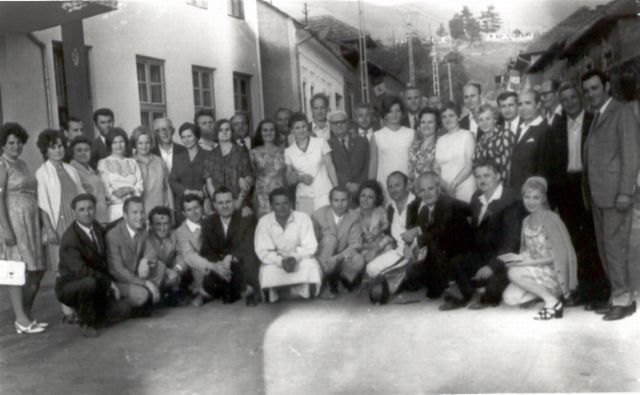
5 July 2006
On the occasion of this year's Nedeia (village feast), Domașnea City Hall organised a series of events marking the commune's history. They celebrated 1,847 years since the first documentary record of Domașnea (159 AD) and 1,900 years since the Roman road that crossed the commune. These historical moments in fact coincide with the beginning of the forming of our Romanian people and with the opening of the path of faith in God. Professor Dr. Victor Crăciun, president of the "Cultural League for the Unity of Romanians Everywhere", spoke of the virtues of our forebears and of the pride of being Romanian. As part of the "Memorial" dedicated to the rebirth of our people's history, Professor Crăciun unveiled a commemorative plaque on the wall of the village school.

The commemorative plaque, one of 30 placed in Romania and across Europe, was blessed by His Grace Lucian Mic, Bishop of Caransebeș, accompanied by a gathering of priests.

On this occasion the mayor of Domașnea, Mr. Petru Lorint, a fine host, awarded the title of honorary citizen of Domașnea to several sons and daughters of the village and to some political and civic figures of the county. The merit of raising the prestige and renown of Domașnea was credited to Prof. Dr. Ilie Cristescu, the writer Ana Calina Garaș, the president of the Caraș-Severin County Council, Eng. Dr. Sorin Frunzăverde, the prefect of Caraș-Severin County, economist Ioan Anton Paulescu, Prof. Dr. Maria Pușchiță, Prof. Ion Răzvan, Prof. Dr. Mircea Roman, honorary consul general of Romania in Canada, Dr. Eng. Tiberiu Serafin and the businessman Dumitru Staicu.

On the same occasion, the Cultural League for the Unity of Romanians Everywhere awarded its "Honoris Causa" diploma "for upholding the ideal of Romanian identity" to all of the above and to His Grace Lucian Mic, Bishop of Caransebeș, the mayor of Domașnea Petru Lorint, the deputy mayor Zarie Benghia, and the councillors Petru Andrei-Ciulicu, Ion Belu, Petru Benghia-Ramba, Gheorghe Izbașa, Mihai Izbașa, Ion Pușchiță-Mutașcu, Ilie Răzvan-Coman, Ion Românu-Tâpu and Nicolae Românu-Budu.
5 July 2004
The Ruga of 2004 brought Domașnea back to its traditional past. Thanks to an enthusiastic group of organisers, villagers who turned or would turn the fine age of 60 that year, the feast of the church's patron saint, St Athanasius, and the village's 170th Nedeia, celebrated on 5 and 6 July, was one of the most beautiful ever held. The folk costume of the Banat mountains, of rare beauty, worn by people of all ages, created that atmosphere of great celebration and the feeling of pride and "fălosenie" (swagger) so typical of the Banat people. Let us name these worthy organisers: Lică Românu-Preda, Ion Guran-Damian, Lică Răzvan-Coman, Gheorghe Românu-Varvarea, Gheorghe Dănescu-Viur, Moise Românu-Ionescu, Ion Paulescu-Tabac, Ion Românu-Is, Toma Horescu-Tomescu, Stana Sitaru, Petria Jubereanu and Ion Jurchescu-Pau. After the lunch the organisers gave at Lică Preda's house for the soloists, Luță Popovici's orchestra and the "Ghiocelul" folk dance group from Giroc, the celebration began. To Luță's music the youngest people of Domașnea started the dance. They were joined by the guests from Giroc and, of course, by the organisers.

The procession set off along a road lined with birch trees, led by the great Banat tárogató player Luță Popovici, whom Domașnea named its first Honorary Citizen on this occasion, heading for the festive ground in front of the Church and the Community Centre.
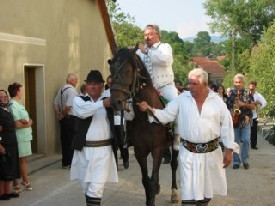

Seated on a specially built stage, the organisers and their wives were introduced to the villagers. The master of ceremonies, Ion Pușchiță, introduced the speakers in turn: the mayor Petru Lorint, who on this occasion presented the title of Honorary Citizen to Luță Popovici; Father Gheorghe Rădulescu, parish priest of Domașnea; the university professors Mircea Roman and Ilie Cristescu; the director of the Giroc Ensemble; and finally the man of the day, Luță Popovici.

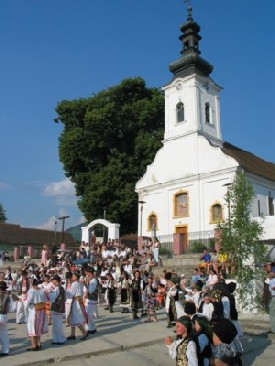
Once the speeches were over, everyone joined the dance and danced into the small hours of the morning. It was a display of joy and pride that will long remain in the memory of those who were there. Their belonging to this village could not have been more evident. Below are some pictures taken on this occasion.


5 July 1972


