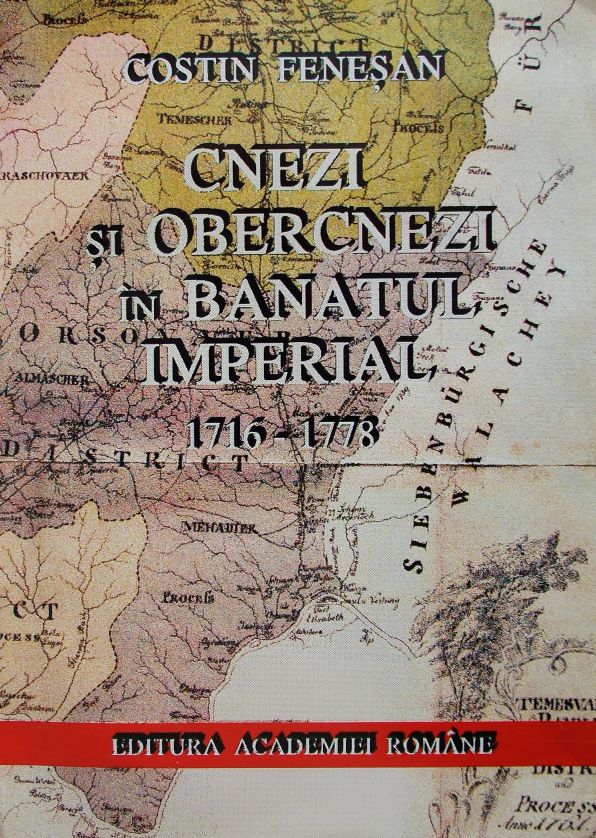
 On 12 December 1716 an important chapter of Banat's history closed, when Pasha Mustafa capitulated and handed the fortress of Timișoara over to Prince Eugene of Savoy. This ended 164 years of Ottoman rule over Banat. What followed would set the development of the region on a wholly different course. Naturally, these momentous changes left their mark on Domașnea too, and we still feel their echo today. The place names of our area were enriched with names such as Pământu' ăl Roșu (the Red Earth) and Turcii ăi Morți (the Dead Turks), all closely tied to the events of that time. Although Banat passed through the hands of many rulers over the centuries, the institution of the knez (village headman) seems to have survived since the beginning of the millennium. More than that, under Habsburg rule this institution grew even stronger, becoming a true Romanian administration within the Habsburg one. Interestingly, the village nickname Chinezu survives in Domașnea to this day, and it clearly comes from the institution of the knez. To someone less familiar with this, the name may of course seem strange and confusing (it sounds like "the Chinese").
In September 1718 the Court Chamber decided to divide Banat into 13 districts (in the end there would be 11). Depending on how many circles belonged to a district, there were one or more ober-knezes (chief headmen) of circle or of district. The institution of the ober-knezes lasted until 1776, when it was decided to reorganise Banat.
The Austro-Turkish conflicts, and especially the Austro-Turkish war of 1736-1739, influenced which side the knezes and ober-knezes took. Considering also the banditry ("lotrie") present throughout the 18th century, we can see the rather difficult position they were in. We learn, for example, of a knez of Domașnea who in 1729 was captured by 5 bandits and managed to escape while his captors were asleep.
In the middle of the 18th century Domașnea belonged to the Timiș circle and was one of the largest villages in the area. An interesting episode of the struggle for power took place in Domașnea between Curea Pepa and Ianăș Zăstran. The name Pepa still rings strongly today: there are a good number of families in Domașnea who bear it. The running of the affairs of the Domașnea village community was entrusted to knez Curea Pepa at the end of 1752. Curea Pepa was valued both by his fellow villagers and by the district authorities, so when the post of ober-knez of the Timiș district fell vacant he was appointed to it, on 3 January 1753. The joy was short-lived, for on 14 February 1753 the administration of Banat issued an order dismissing Curea Pepa. The order caused consternation and uproar. It seems that a rival candidate for the post of ober-knez had denounced Curea Pepa for alleged involvement in the Austro-Turkish war, when he supposedly went over to the Ottomans; there was talk of treason and slave trading. The denunciation seems to have come quite quickly, because on 10 February the administration in Timișoara asked the Caransebeș district office for details of the suspicions hanging over Curea Pepa. The man who made the infamous denunciation was Ianăș Zăstran. He was not only a fellow villager of Curea Pepa but had also been his deputy. And so Ianăș Zăstran became the new ober-knez.
Because of his abusive conduct and negligence, ober-knez Ianăș Zăstran fell into disgrace. On 30 September 1753 Berza Berzescu of Teregova submitted a petition to the Court inspection commission of Kempf von Angret, then in Mehadia. The petition was written on behalf of 29 villages of the Timiș district. The same charge of having been a "seimen" (a collaborator of the Turks) was brought against Ianăș Zăstran. This, however, was not the reason for the petition; the reason was rather how Ianăș Zăstran had come to hold the post: not with the consent of the villages, but through the self-interested intervention of some friends. Perhaps even this would have been forgotten had Ianăș Zăstran's later behaviour been exemplary. Instead he had become a burden on all 29 villages, because he did not deal with complaints and was drunk most of the time, so that honest taxpayers were constantly troubled. As an aside, I could mention another interesting parallel between the term seimen and the village nickname Saimenu, which to my knowledge is still borne by at least 2 families in Domașnea today. It seems that for lack of time the commission, overwhelmed by the many complaints, did not manage to settle the request of the 29 villages. The abuses multiplied, so in March 1754 the villagers again petitioned the commission, this time with concrete accusations. The commissioner was also reminded that ober-knez Curea Pepa had been elected according to proper procedure and had carried out his duties correctly and honestly. The accusations against Ianăș Zăstran pointed to embezzlement and to 120 cartloads of hay taken from his fellow villagers in Domașnea. What is more, in Feneș he forcibly mowed the villagers' pasture and made them pay for his stay. Thanks to his privileged ties with some members of the district administration, these accusations could not decide his dismissal. The accusations of collaborating with the Ottomans in 1738, on the other hand, were going to cost him. He had apparently sheltered some Turkish soldiers for 3 months and shown them the way to the Caraș Valley. What is more, he had allegedly sold several Romanians and Germans to the Turks and been rewarded by the pasha with two oxen, which he used for 2 years. Zăstran was also said to have lured four imperial cavalrymen after the battle of Cornea on 4 August 1738, promising to take them to the main army, but instead he led them into a forest, robbed them and sold their weapons to the Turks.
The Court commissioner's decision may also have been influenced by the petition of the former ober-knez Curea Pepa, who tried to clear his name without attacking Ianăș Zăstran, asking at the same time to be reinstated if the accusations were not proven. The commission of inquiry went on to hear the delegates of the 29 villages, both to establish the truth of the facts and to learn their vote for one of the 3 candidates: Iosif Bumbăcilă of Teregova, Curea Pepa of Domașnea, and another candidate who was probably a straw man of the administration. The representatives of Domașnea who appeared before the commission were Curea Pepa, Vela Horăscu and Mihuț Curescu. They accused Zăstran of having taken 35 florins from the community (a coin of the Habsburg imperial administration, worth 60 kreuzers) and of pocketing 100 florins received from the Caransebeș District Office. They also stated that Zăstran had not been a seimen, and they gave their vote to Iovan Bumbăcilă, although they knew the villages wanted Curea Pepa as ober-knez.
Asked about the accusations against Zăstran, Berza Berzescu pointed to the knezes of Teregova, Armeniș and Domașnea. The one from Armeniș said he had not been a witness. The knez of Teregova, brother of the one from Domașnea, was also heard; he stated that he and his brother had taken part in the attack on Vršac wearing turbans.
At the end of the hearings Zăstran was questioned and confronted with the accusations. His statements muddled things even further. According to Zăstran, Ianăș Bumbăcilă (father of the candidate Iosif), together with 19 other seimens (one of them Curea Pepa), came to Domașnea in 1738 and forced him to show them the way to Bela Crkva. The pasha there supposedly offered to let him stay with the Turkish army. He refused, and as he left the pasha gave him 2 oxen. As for the 4 cavalrymen, he claimed that while he was showing them the way to Transylvania, 12 villagers from Teregova attacked them, and only his intervention saved the imperial soldiers' lives. On parting, he said, they gave him 4 pistols as a reward.
Zăstran was dismissed for his abusive conduct. On the other hand, both Zăstran and Curea Pepa were guilty of siding with the enemy, so neither could be appointed. Iovan Bumbăcilă was named ober-knez. His father, Ianăș Bumbăcilă, had himself been a captain of seimens. In those times it was very hard to find a candidate who had kept his oath of loyalty to his sovereign unbroken. In this way the two Domașnea candidates for ober-knez lost for good. Nothing is known of what became of Zăstran, but Curea Pepa remained knez of Domașnea and would play an important part in his fellow villagers' resistance to the decision to set up the Military Frontier in the Banat mountains.
Finally, I would like to thank Mr. Costin Feneșan for bringing to light this interesting episode of Domașnea's history, and also for the book "Cnezi și obercnezi în Banatul imperial 1716-1778" (Knezes and Ober-Knezes in Imperial Banat, 1716-1778), which he generously gave me.
Bibliography:
Costin Feneșan, Cnezi și obercnezi în Banatul imperial 1716-1778, Editura Academiei Române, 1996.