The testimony of Corneliu Horescu Blănaru in the volume "Analele Sighet 7, Anii 1949-1953: Mecanismele Terorii" (The Sighet Annals 7, The Years 1949-1953: The Mechanisms of Terror), Fundația Academia Civică, 1999.
My first childhood memories are of a goods wagon taking me, at the end of the summer of 1949, from Domașnea in Caraș-Severin County to an unknown destination. Eastwards.
I had just turned three and was with my family, or rather with what was left of it, because my father, Spiru Blănaru, had fought in the Banat Mountains and had been caught by the security forces in the spring of that year. He was wounded in a hard and unequal clash, probably the result of a betrayal. Tried that summer, he was sentenced to death and executed in Timișoara. At the same time his comrade, Ion Caraiman, a peasant from Feneș and a man of high moral standing who loved God and his country, was shot dead.
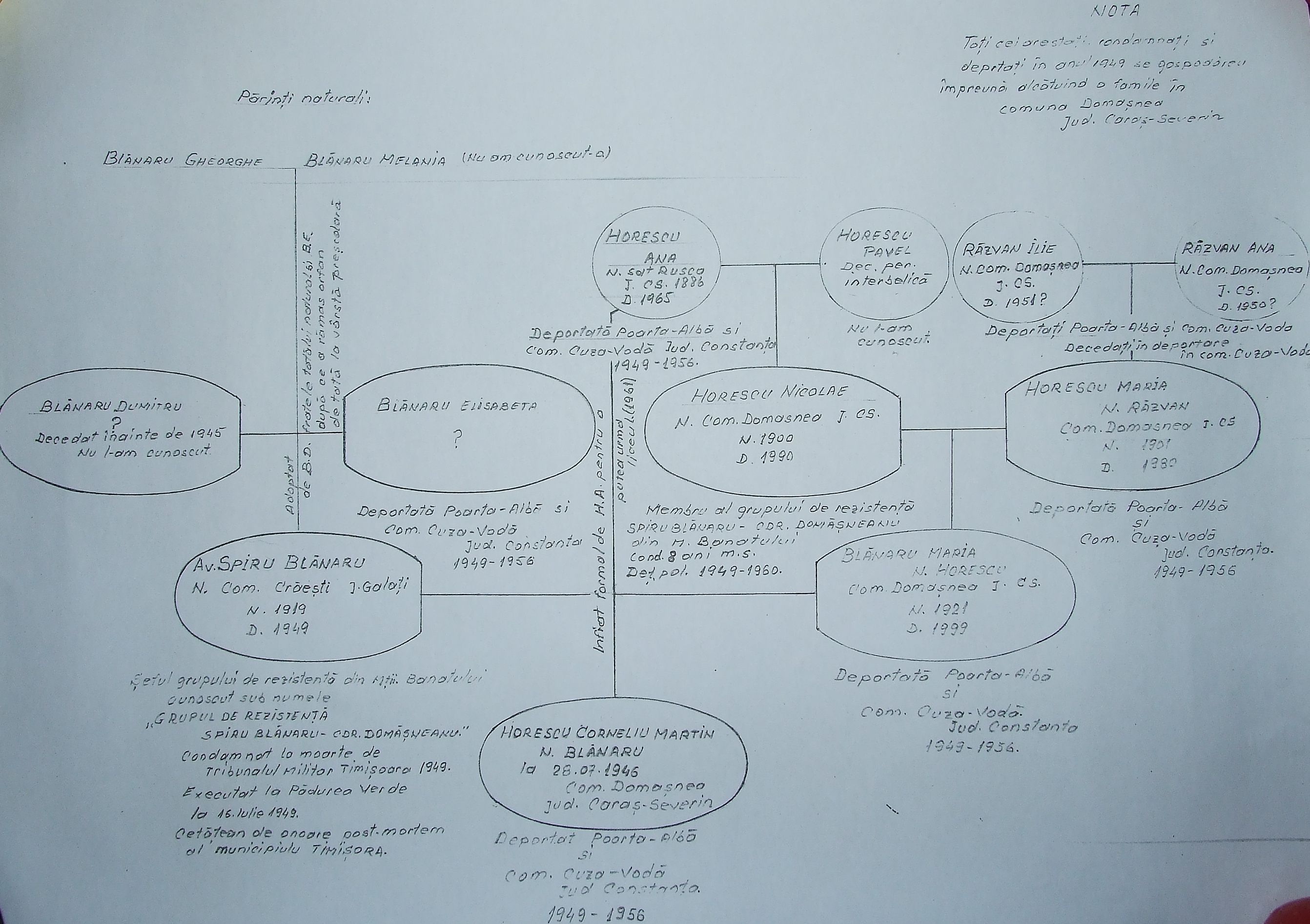
Cornel Horescu's family tree, with details
In those years, 1948-1949, my mother's father, Nicolae Horescu, and my mother's sister, Anișoara Olteanu, née Horescu, a student, had taken to the mountains. They held out until after our deportation; then, in the autumn, they were arrested and sentenced to long, hard years in prison. So in the goods wagon were my mother, Maria Blănaru, gravely ill with her lungs; my mother's mother, Marița Horescu; my father's mother, Elisabeta Blănaru; and three great-grandparents: grandmother Marița's parents, Ilie and Ana Răzvan, and my grandfather's stepmother, Ana Horescu. Old people, sick people and children set on the road of exile, to demonstrate... "the lofty socialist humanism". Taken away with us was also the family of the anti-communist fighter from Colonel Uță's group, Petru Pușchiță, known as Mutașcu, of Domașnea: Maria Pușchiță with two of her children, Ion Pușchiță, who was nine, and Eva, a little older, aged twelve. From Teregova they brought the wife and mother of Ion Marițescu, the fearless fighter of Spiru Blănaru's group.
I learned later that we did not know our destination at the time. There was talk of the Bărăgan or, worse, of Siberia, about which horror stories circulated, and not without reason. But back then I did not grasp how dramatic the situation was. I found the change of scenery interesting, and to the tearful, worried faces of my relatives I offered some encouragement, as I was told later: "Never mind, Mummy, this will pass too."
I understood that the militiamen of the escort, who took us over in Bucharest, behaved fairly well; at the stations they asked for food for us and milk for the children, because we had left home with only the clothes on our backs and a few hand bags. From Domașnea to Bucharest we were escorted by Securitate men. They treated us neither badly nor well; they simply did not talk to us. My clearer images are of an autumn afternoon under the Dobrujan sun, the end of the journey. Our family breathed a little easier, because the danger of Siberia had passed, for now. Large militia forces were waiting for us at Basarabi station; they had been told that a dangerous group of "bandits" from Banat was coming, "hardened enemies of the people". They were rather taken aback when they saw the group that stepped off the train. They really did not know what to do with us: we did not have the status of prisoners, and we could not be used on the Canal works, given the physical state of the group. In the end we were quartered at Poarta Albă, in wooden huts, on a site outside the Canal labour site where the political prisoners slaved. As far as I remember, we also lived for a while at the headquarters of a farm that had once been private. After less than a year we were moved to the commune of Cuza Vodă and lodged with villagers' families.
Here I would like to say that most of the militiamen we dealt with, both during the journey and later (once a week or every two weeks there was a kind of roll call of the deportees, read out from lists by a militiaman, the so-called "presentation"), looked on us with understanding and compassion. Perhaps the indoctrination and brainwashing meant to produce the "new man" had not borne much fruit. Or perhaps, being further from that last circle of Hell that the Romanian political prisons were, they were all more humane.
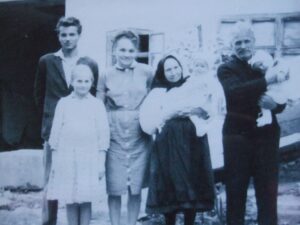
The Horescu family in the 1970s
Families from Bihor County, Romanians and Hungarians, were also brought to the commune. I do not know by what criteria those deportations had been made, because I do not remember them having been part of the Resistance. They faced misfortune with dignity, and we became friends and supported each other. The villagers of Cuza Vodă proved to have great solidarity and humanity. Well-off peasants and good farmers, after our arrival they began to suffer the ordeal of the quotas and the horror of the methods of "persuasion" to make them join the Collective Farm. Until we managed to scrape together something of what we needed for daily life, they helped us in secret, leaving food at our door at dawn. Needless to say, such a deed could then be classed as "Legionary aid" and was severely punished.
In the first year of our stay in Cuza Vodă, my great-grandmother Ana Răzvan passed away, and then my great-grandfather, Ilie Răzvan, "taica Ilie". My mother's lung disease grew worse, and she went into Balotești Hospital near Bucharest for a complicated operation. She left in secret, but the commune's militiaman knew. I do not want to think what would have happened to the poor man had it come out. Fortunately, her illness improved after the operation and my mother came back to Cuza Vodă. Only when she was due to leave hospital did the militiaman report the "bandit woman's" disappearance and her discovery in hospital. He went to bring her back under escort, for my mother's good, since I do not think she could even have come back alone, so weak was she after the operation.
"The wind of God blows when it will and where it will"...
We had two rooms in the house of an old man, Radu R. Mihai, who lived alone, as he was a widower and his two daughters were married and settled in Constanța. In the seven years we stayed there we became almost a family. When we left, the old man was alone again. He saw us off at the gate, watching us drive away in the cart on the dusty road to Medgidia. There were tears in his eyes... May God place him among His righteous!
Over the years, things settled into an abnormality that came to seem almost natural. My family found work on the state farm in Medgidia or at various enterprises: they had the status of workers, and we got by somehow. Unfortunately, as I said, very hard times came for the villagers. The quotas and the "persuasion" to collectivise were savage, and in the first years after 1950 they left well-off, hard-working people nearly starving through the winter. Among us, the village children, terrible stories were whispered. My little friends told how their parents were held in the evening, taken to the cellar of the town hall and beaten until they lost consciousness. Water was thrown over them. Because they had not handed over their quotas and refused to join the collective farm; before dawn some escaped home through a cellar window, to hide a sack of wheat or kill the pig, so it would not be taken from the yard as quota and the family could get through the winter. One morning, playing near the town hall, we saw that window walled up. It had become a little opening in the wall, with no glass, a little bigger than a child's hand. A hard winter was coming. Around 1952-1953, my good friend and later deskmate in the first school years in Cuza Vodă, Costea, ate at home, far too often, only boiled maize. That was about all that had escaped the fury of the quotas in the larder. He had only a pair of short trousers, and it was getting colder... My mother had made me a pair of trousers from flannel bought with ration coupons. With yellow and brown checks... Then it snowed and I called Costea to go sledging. We had a sledge given to us by our neighbours, Ion the blacksmith and his wife, Auntie Mița; it had belonged to their older children, who were away at school. "I'm cold," Costea told me, "but never mind, Cornel, when I get my trousers from Mr. Dumitru the tailor, we'll go sledging all day." Spring came and Costea was still in his short trousers and three pairs of ribbed stockings. Then it got warmer and warmer, and we forgot about sledging and trousers. It will remain a mystery whether that winter the cloth for Costea's trousers was really at Mr. Dumitru the tailor's. I tend to believe it had never even been bought. Because in the Romania of those years, and still less in Cuza Vodă, there was no tailor who would leave a child without trousers. Paid or not...
That, seen through a child's eyes, is how "the bright road of socialist agriculture" began. By the end of our stay in Cuza Vodă, in 1956, the commune had been collectivised. The people's resolve had been broken by torture, cold and hunger. And it was reported, as I would learn later, that "collectivisation has been completed in the first region of the country, Constanța". Yet another crime against the Romanian people was to be committed: tearing the peasant away from his land, his tradition and his spirituality. But with collectivisation, the villagers' struggle at the edge of survival also came to an end.
In the autumn of 1956 came the order releasing us from deportation. We returned to Domașnea, to start life more or less from scratch. We found the house and the land (Domașnea had no collective farm at the time), and nothing else. I was to start fourth grade there. For those who fought and suffered for God and country, I quote a passage from a trilogy by Bujor Nedelcovici:
"We did not kneel before the Apocalypse that announced its coming, or else we would forget that we are immortal."
Finally, we would like to thank Mr. Cornel Horescu for the material he provided.