Back in time: Domașnea, 159 AD. Redivivus, brought back to life!
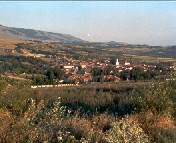
To put an end to the many raids of the Dacians into Moesia, which had become a Roman province around 9 AD, and to conquer Dacia and turn it too into a Roman province, in 98 AD the Senate of Rome entrusted Emperor Trajan himself with this task. As a result of the preparations for war, the fighting, and the settling on our land of many colonists who stayed on after the Dacian-Roman wars, there are numerous archaeological remains showing that this land has been inhabited since antiquity. Our parts too, even our very village, played a major role in the course of events, which shaped the organisation of the whole region and left posterity the imprints of an ancient civilisation. Three such remains mark the presence of the Roman armies on the land of our commune at the beginning of the first millennium AD:
- THE ROADS
Strategically, the roads were the essential means for military operations. Along the roads and right next to them, forts were raised to defend the conquered territory.
From the great road known as "VIA MAGNA ROMANA", which starts from the Adriatic Sea, crosses Upper and Lower Moesia, runs along the right bank of the Danube, and goes beyond it as far as Varna and Constantinople, three other operational roads branched off for the campaigns in Banat, all known as VIA ROMANA or VIA TRAIANA.
The second of these roads, passing through Taliata in Yugoslavia, opposite the mouth of the Cerna, crossed the Danube on a pontoon bridge at Tierna-Dierna-Orșova, went up the Cerna valley, over the Domașnea Hill pass at 540 metres, and along the Timiș valley to Tibiscum, and from there along the Bistra valley through Aemonia, Pons Augusti (Marga), Sarmizegetusa Ulpia Traiana, Aquae (Călan), Blandiana, Apulum (Alba Iulia, seat of the 13th Legion Gemina), Potaissa (Turda), Napoca (Cluj) and Porolissum (Zalău). This road crosses the commune of Domașnea, between the communes of Cornea and Teregova, for about 7 km. About 1 km in, level with Domașnea railway station, it turns left onto the Luncavița road, continues over Hotara and Față, from where it crosses to Culme, runs along Ciurel Hill and Domașnea Hill through Vârtoape, and descends to Porta Orientalis, where it again joins today's national road towards Teregova and Caransebeș on the bank of the Timiș. A feature of this road is that in places it is paved with rough stone set on edge, and on the crest of Domașnea Hill it is crossed by a road that comes from Porta Orientalis and joins the national road right on Domașnea Hill, where the traces of the third remain were recently found, and it runs on for another 100-150 metres to today's television relay. This second road of Banat, which thus also crosses our commune, passed along its way the fortress that became the municipium of Tierna, and the forts of Ad Mediam (halfway between Tierna and Tibiscum), Praetorium (Plugova), Ad Pannonios (Domașnea), Gaganae (Teregova), Masclianae (Ilova) and the municipium of Tibiscum (Jupa, near Caransebeș), and continued through Apulum to Porolissum.
The third Roman road built by Trajan is the one opposite Drobeta-Turnu Severin, which crossed the Danube from Egeta in Yugoslavia over the bridge built in 103-104 AD by the great architect of the age, Apollodorus of Damascus; it lasted only 19 years, being demolished under Emperor Hadrian to stop the incursions of the raiders from across the Danube who threatened the whole region. Along this third road the Roman troops advanced for the final battle at Sarmizegetusa Regia in 105-106 AD.
There has never been any controversy or doubt about the existence of Roman road no. 2 and its route across our village. It was identified as early as 1828 by the architect Boleszny, and its traces are still easy to see today; it was the only usable road until 1828, when his team of Austrian road workers built a new route across our commune, next to the old one and parallel to it, but about 1 km further north-east (today the E94 Bucharest-Timișoara national road).
The other two remains, the fort of Ad Pannonios and the third, which can be none other than the House on Domașnea Hill, have still not had the places where they stood pinned down, after more than 18 centuries; and this is our fault, for remaining indifferent and careless towards a heritage handed down as a gift by those who conceived the Latin race and our Romanian people.
We therefore believe that the research, soundings, efforts and so on made by people who are not versed in archaeology should also be taken into account. Being from these parts, through their perseverance, insight, self-denial and zeal for the good name of their native village in general, and for the need to uncover the truth in a matter of historical interest in particular, they can tip the balance in locating the places that served to Romanise these lands and plant civilisation here so long ago.
- THE FORT "AD PANNONIOS"
Ever since I was a small child, not yet at school, my grandfather's brother, Ilie Rumunu-Roman (1837-1923), and my grandfather in direct line, Ion Rumunu (1842-1878), both serving in the 13th Romanian-Banat Frontier Regiment, told us stories. After grandfather Ion's early death, Ilie, as the mentor of our family, sensing the need to share something of the past with his grandsons Mitruț and Ion, told us how, as a child, he used to play at war with the other children of Domașnea and Cănicea, in two separate warring bands, on the meadow at Coveiul lui Iocsa, where there were many pieces of brick which, he maintained, came from the walls of a fortress on that spot.
In 1953-1954 I was employed on the works to collect water for the railway locomotives (a drainage channel and a storage basin), and in those two years not a day went by without my rummaging after those bricks, trying my luck at finding at least one brick stamped with the symbol XIII in Roman numerals. In fact countless fragments of pottery were found, but none with the inscription of the 13th Legion, based in Alba Iulia (Apulum), to which the unit quartered in that fortress belonged. The older workers from the village of Cănicea, however, confirmed to me that they knew from their forebears that whole bricks bearing some signs, scratches, had been dug up from this very spot and carted to their village.
Among archaeologists, historians, university professors and researchers, only Professor Alexandru Borza of Cluj and the archaeologists Boleszny and Millecker spoke in favour of the probable existence of the fort at Domașnea. Professor Constantin Daicoviciu, rector of the University of Cluj, I. Miloia, director of the Timișoara museum, and Professor I.I. Russu, also of Cluj, were more reserved about the existence of the fort at Domașnea, and now, recently, the monograph of Caraș-Severin County does not even mention that our village had any remains of Roman origin.
In the 1970s, with the help of my cousin Dr. Iancu Munteanu, also from Domașnea, after a painstaking search of the museums of Vienna, I obtained a photocopy of document D XIII directly from the Museum of Antiquities and Numismatics in Vienna. It contains the report of the group of road workers who discovered the stone foundation, 40 m by 34 m, on Domașnea Hill, over which the Orșova-Caransebeș national road now passes. Next to the foundation another document was found, a bronze tablet containing the citizenship certificate of the war veteran IVONERCUS, of Celtic origin, who after 25 years of military service was granted citizenship together with his whole family and lived in that house, a domus-mansio, certainly built at the same time as the fort of Ad Pannonios.
At first sight this photocopy pointed to a coincidence between the year that Roman foundation was discovered and the year the little church in the village of Cănicea was built, which suggested to us a new direction, a new search towards and in the hamlet of Cănicea. On the other hand, an indiscretion, this time more than welcome and truly auspicious, from Father Rădulescu, one of the two parish priests of the churches of Domașnea and Cănicea, that he too had glimpsed some hieroglyph-like scratches on some bricks in the paving of the altar at Cănicea, a hint borne out by what I knew from grandfather Ilie Roman's stories of more than 75 years ago, led to the following: on 21 August 1981, going there with the family of Professor D. Blaj, my cousin Eugen Feneșan, a former magistrate, and Father Dorin, the second priest of Domașnea, we found to our complete satisfaction that the church altar is in fact paved entirely with such bricks stamped with the symbol XIII of the Legion of Apulum. It is likely that the nave of the church, now covered with concrete slabs, also has a former brick paving beneath them. On many of these bricks the stamp can barely be made out, and most of them had been laid with the stamp facing the ground, which left no doubt about their origin: they were the ones we had been looking for, from which it was concluded that they belonged to the fort of Ad Pannonios, only 2.5 km from the church.
With this very important detail in hand, what remains to be explained for this chapter is the origin of the term Pannonios and of the accusative preposition Ad that precedes it. It refers to the place, province or land from which the auxiliary troops that made up the garrison of the fort of the same name were brought: Pannonia, from where the dependants were also brought, the families of some of the auxiliary soldiers, who came with the heads of their families and settled in that house on Domașnea Hill, certainly built at the same time as the fort of Ad Pannonios. Already in Roman times it formed the base of a vicus, a settlement, from which came the name the Slavs later gave our village: Domașnea.
- THE HOUSE
It may be assumed that the word Domus (house in Latin) was overlaid by the Slavic Domas, and with the addition of the suffix "ia", also Slavic, it became Domasnia, the name our village has borne since the 6th century, which coincides with the age of the migrations of peoples, the 3rd to the 9th centuries.
It is well known that the Roman auxiliary armies were made up of men from all the provinces of the Roman Empire: Italy, Hispania, Britain, Gaul, Germania, Illyria, Dardania, Moesia and, in our case, Pannonia. From them were formed the sub-units that were also entrusted with guarding the roads and that manned the forts. When they were stationed in the forts, they brought their families with them, for whom houses were built: individual canabae, dwellings, shared households near the military units or sub-units. Their families lived there, and so did the war veterans, who were given due attention: they were granted a plot of land and farmed it for the rest of their lives.
The house on Domașnea Hill was such a house, 40 m by 34 m, serving as a home for about 25 families. Over time this mansio grew too small, as the number of those who joined the ranks of the veterans kept growing; marrying Dacian women, they built their own homes, the so-called canabae, around these houses.
In this way, in a relatively short time, a true civil settlement was formed, a vicus, at most 2 km north of the fort of Ad Pannonios, on the land of our village.
In the foundation of this house, when its stones were lifted in 1828 (which proves it existed) and rebuilt into two trapezoid retaining walls, each 8 metres long, only 23-30 m further downhill towards the village of Domașnea, to strengthen a stretch of the new E94 national road built by the same team of Austrian road workers mentioned in document D XIII in Vienna, the bronze tablet was found containing the proof of the honourable discharge of the war veteran Ivonercus in 159 AD.
This bronze tablet is therefore the document showing that 159 AD is the year the veteran Ivonercus, of Celtic origin, was discharged, and also a year in which these houses existed. The existence of such houses, perhaps of the same age, is borne out by the many lists of domus, mansiones and vici mentioned in the charters of the beginning of the second millennium, such as that of 1075, by which King Géza of Hungary donated dozens of such houses to the Benedictine monastery; the deed of gift of King Béla II to the monastery of Dömös (in today's Hungary) of 1138, listing the households (mansiones) that had to provide salt (blocks of salt) and so on; and also by the recent discoveries of the archaeologist Dr. Doina Benea of Timișoara, who found, besides several multi-level dugout dwellings, an imposing house with dozens of rooms at Jupa (Tibiscum).*
It is true that the term, the name House, seems to us something unimportant, something banal; but for that time, a house the size of the one on Domașnea Hill was considered a fortress, a rarity, especially if you look deeper into its etymology, its place in social life and its purpose, which served a grand aim: the Romanisation of these lands. The significance of this term should not be underestimated. Even today it stands for the foundation of a village, of a town and even of the state: the Commune House, that is, of a community; the City House, of a larger community; even the House of the Country, that is, Parliament; or the House of the Army, so often used in our days, whether in recognition of its role and importance or as a duty to institutionalise it as a factor of the first order in social life.
Once the existence of that House on Domașnea Hill has been established with certainty, any claim that it might stand in place of the fort of Ad Pannonios at Coveiul lui Iocsa is ruled out, if only because such forts were placed, as a matter of principle and exclusively, next to rivers with as large a flow of water as possible; whereas the little spring called Gârdomin, next to that building (which almost dries up in summer), could not have supplied water even to a unit of no more than 50 soldiers. Besides, the space within 40 m by 34 m would be far smaller than the space needed even for such a unit of soldiers.
It is also worth mentioning that about 15 years ago, on the good arable land downhill from the House (called La Ibraitaru), the churchwarden Meila Marinca found a Roman silver denarius behind the plough. He handed it to Father Ilie Adamescu. It surely belonged to some war veteran and was earned through his trade as a carter, since we know that the families of the war veterans practised this trade, besides farming and cattle raising, from the time they settled in these parts and for centuries afterwards. At that time, as the Danube gorge and the cataracts at the Iron Gates blocked traffic on the water, the goods unloaded at Tierna-Dierna-Orșova were carted to the municipium of Tibiscum exclusively along the Timiș-Cerna corridor, over the pass on Domașnea Hill.
These brave Romans of Celtic origin, Pannonia having been a Roman province since the beginning of the 2nd century, from where they had been brought a century earlier to man the fort of Ad Pannonios on the land of our village, secured an enviable living through their new trade as carters, became independent and no longer had any connection with the army. When the Roman armies withdrew from our land under Emperor Aurelian, around 274-275 AD, they had the choice of leaving for a new unknown or keeping the enviable position they had made for themselves.
Of course, the disaster that followed the torrent of barbarian invasions, of the Carpi, Goths, Huns (375-453), Gepids, Avars and Slavs, from the 3rd and 4th centuries on, had catastrophic consequences for the population that remained after the withdrawal of the Roman armies under Emperor Aurelian. Thanks to the lie of the land and its hiding places, however, they escaped the invaders more easily, so that the Slavic people found them on the land of our village and in the House (the domus) on Domașnea Hill, naming it Domas, and with the addition of the suffix "ia(n)ia", also Slavic, it became Domasnia. And so those Galli, as the Romans called the Celts, once things had settled, kept their standing as descendants of war veterans and could carry on their dangerous trade as carters.
In this respect, the evidence of the continuity of the Romanian element on the soil of Trajan's Dacia, upheld so competently by our scholars, historians and epigraphists such as Xenopol, Onciul, Iorga, Pârvan, Oțetea, Constantin and Hadrian Daicoviciu and others, and supplemented by countless proofs of foreign origin, refutes and overshadows Roesler's theory of the end of the last century, and affirms the presence of the Vlachs immediately after the departure of the Roman armies in 274-275 AD.
Let us recall the German poem "Nibelungenlied" of the 12th century, which, drawing on historical and mythological sources, lists among those present at the 5th-century wedding of Attila to the beautiful Kriemhild, alongside Russians and Greeks, the Vlachs with their duke Ramunc (a Romanian): "Der Herzoge Ramunc, uzer Vlachen lant".
Telling too is the maxim "Solis Valachis remanentibus" of the Hungarian historian Thuróczy, which reflects the fact that they, the Vlachs, stayed in place; that is, not even the rule of the Huns (from whom the said Hungarian historian himself traced his descent), harsh as it was, could drive them from the hearth where the Roman Eagle had placed them.
The Hungarian historian András Huszti stated in 1701: "No nation has a language as close to Latin as the nation of the Vlachs, which is a sure sign, and one that cannot deceive, that they are the descendants in Transylvania of the old Roman colonists."
Indeed, Count Teleki, president of the Transylvanian Court Chancery, did not doubt the continuity of the Romance population in the Carpathian-Danubian lands either, acknowledging in 1791 that "the Romanians are the oldest people of Transylvania".
How much force of affirmation can lie in the example of a single "Salute" from a crowned head, in this case Emperor Joseph II (1765-1790)! When his subjects in northern Transylvania, gathered from four villages, came out to meet the Emperor, he greeted them in their ancestral language, "Salve Parvae Nepos Romuli" (I greet you, humble descendants of Romulus), and in reply they immortalised their four villages by naming them "Salva-Parva-Nepos-Romuli".
There could hardly be a clearer acknowledgement or a more direct expression of admiration for the Latin origin of his subjects, and for the fact that they had presented themselves to their sovereign in their authentic Daco-Roman dress.
Looking at the existence and persistence on the land of our village of families named Galea, Galuț and Galescu, the Galești, who over many generations kept the trade of carters, we are entitled to believe that they are among the descendants of the Celts (whom the Romans called Galli). They are among the oldest families of the village.
At the same time, the sons and daughters of the village have the duty and the right to set up a village museum, to which every citizen will contribute, even if only a single object from the distant past.
We express our gratitude and thanks to Professor I.I. Russu of the University of Cluj, a kind guide, for his insistence on shedding light on the matter, thanks to which our village in turn can enjoy the happy position of being the undisputed hallmark of these remains.
We thank the village school, which, led by Professor Boscota, did not remain passive in the need to bring out the truth, a great truth, after a wait of more than 18 centuries, by searching the land and gathering the fragments of brick from those times.
Vivat, Crescat, Floreat!
Dr. Dimitrie Roman
August 1983
BIBLIOGRAPHY
Borza, Al. (1943) Banatul în timpul romanilor, Timișoara.
Daicoviciu, C. et al. (1960) Istoria României, vol. I, Editura Academiei Române.
Giurescu, C.C. (1944) Istoria Românilor, Editura Cugetarea.
Giurescu, C.C., Giurescu, D.C. (1971) Istoria Românilor din cele mai vechi timpuri până astăzi, Editura Albatros.
Jukov, E.M. et al. (1959) Istoria Universală, translated from Russian, Editura Științifică.
Oțetea, A. et al. (1970) Istoria poporului român, Editura Științifică.
Pârvan, V. (1967) Dacia. Civilizațiile antice din țările carpato-danubiene, Editura Științifică.
Russu, I.I., Pippidi, D.M. (1975) Inscripțiile Daciei Romane, vol. I, Editura Academiei Române.